
Post-LARP Blues & Bleed
Con drop, bleed, the grey Monday after — why the emptiness comes, and what actually helps.
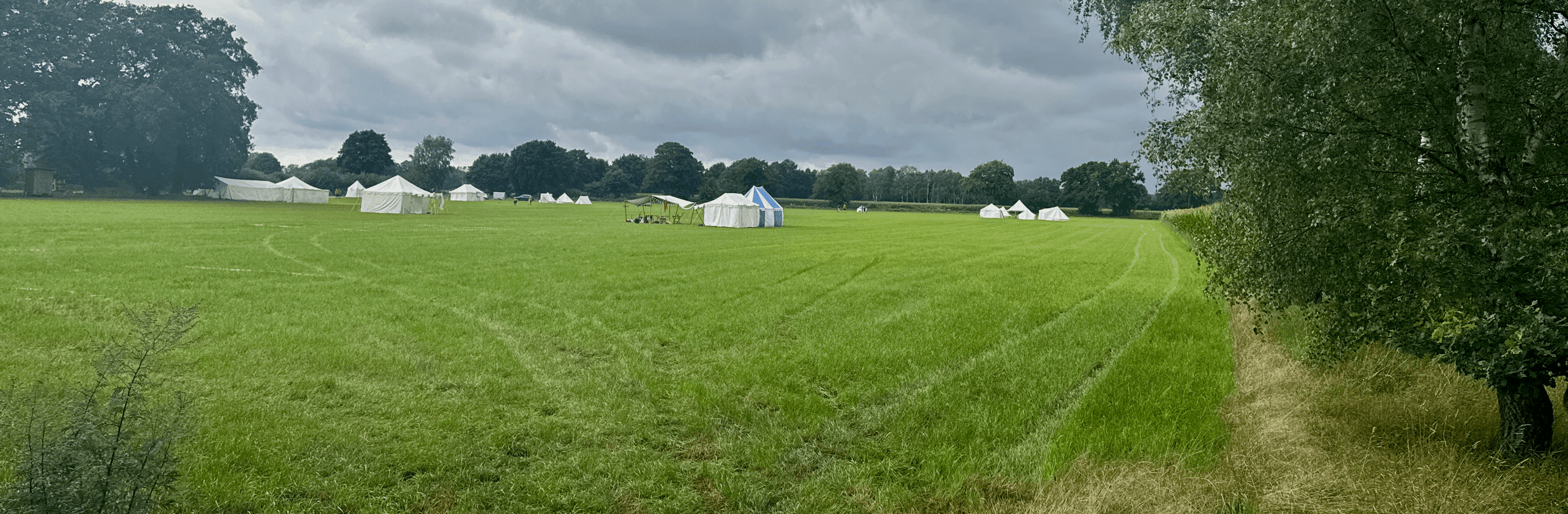
Monday morning, just before seven. The alarm pulls you out of a dream where torches were still burning. You reach for your phone instead of your belt. Your kit is still lying in the hallway, half damp, smelling of smoke, rain and forest. Everyday life is waiting on your screen — and something inside you says: That was it? Already?
If this sounds familiar, you are in good company. Almost everyone who has spent a weekend genuinely living inside a character knows that grey Monday. The scene has many names for it: post-LARP blues, con drop, larp drop, the comedown. And although so many people experience it, hardly anyone talks about it — as if it were embarrassing that a game can linger this long.
It isn't. It's the ordinary price of having actually committed.
What's really going on: bleed
There's a term for the phenomenon behind it, borrowed from Nordic larp discourse: bleed. The German-language LarpWiki describes it as the influence of a character's emotions and thoughts on the person playing them — or the other way around. Two directions are distinguished:
Bleed out runs from character to player. Your warrior loses her sword-sister storming the bridge — and you sit by the fire afterwards and are genuinely sad. Not performing sadness. Sad.
Bleed in runs the other way: you arrive tired, irritated or in love, and your character carries it into play. Usually less troublesome, but it shapes how you play.
The concept has been discussed in international larp scholarship since the early 2010s, among others by Markus Montola, Sarah Lynne Bowman and Whitney "Strix" Beltrán. Bowman describes not only painful forms but also cathartic bleed: those moments where character and player cry at the same time — and it feels right afterwards.
Which is the part many people miss: bleed isn't a bug in the system. Bleed is proof that it mattered to you.
Why the emptiness comes
German author Alexander Jaensch coined a useful image for this in 2016: the Auswurfschock, roughly "ejection shock". In his description, your mind has two jobs at once after an intense event. It has to shift from the dense rhythm of the game site back to everyday pace — while simultaneously processing a large, unsorted pile of memories: conversations, glances, fights, decisions, three days of meaning packed into forty-eight hours.
No wonder the Tuesday after feels flat.
Sarah Lynne Bowman and Evan Torner described the same state in 2014 under the English term post-larp depression — while explicitly stressing that it is not a clinical diagnosis. Many players deliberately reject the word "depression" for that reason. The comparison the authors draw fits better: it's the low that follows a very intense shared experience, much like the comedown after conventions, big festivals or long trips. A common explanation is the fading of the physical and emotional high of the event. That model isn't firmly proven — but it describes the feeling well.
Six things that genuinely help
1. De-role — put the character down on purpose. Maury Elizabeth Brown describes simple, effective rituals: deliberately and slowly removing the last piece of costume. Changing location. Physically shaking the character off. Saying your own name out loud. It sounds almost silly — and works precisely because it gives your return a clear moment, instead of letting it happen somewhere between teardown and the motorway.
2. Tell your stories. War stories aren't bragging, they're processing. Tell a scene three times and you'll sort it differently by the third telling. And hearing how the same moment looked from the other side of the campfire often hands you half the story you never had.
3. Use the photos — but later. Images are memory anchors. They bring back scenes that would otherwise fade into fog. Give yourself that folder on an evening when you have time for it, not between two meetings.
4. Look after your body. Aftercare sounds bigger than it is: sleep, a hot shower, real food, water, one day with no obligations. A good share of the Monday blues is simply exhaustion with a dramatic name.
5. Talk about it as a group. A short debrief — best moment, hardest moment, what you missed — ties loose threads together. The attitude matters: voluntary, no pressure, no competition over the best scene. Brown rightly warns that post-play conversations can do harm when participation is expected, or when everyone drives home feeling the others had the more interesting event. Nobody who doesn't want to talk has to.
6. Thank the organisers — and give feedback. It sounds like a courtesy, but it's good for you too: it closes the event. And it helps a volunteer team make the next one better.
What organisers, GMs and groups can contribute
Post-event care isn't the players' private problem. It can be designed in, and it costs little:
- A clear ending. A shared close after game off — a word from the GM team, a circle, one last moment — marks the border between game world and drive home.
- Room to de-role. Time and space after teardown where nobody has to be in character any more.
- Voluntariness as a principle. Offers, not mandatory programme.
- A signal after the event. A message in the group chat two days later — "how's everyone doing?" — takes thirty seconds and reaches exactly the people currently assuming they're the only ones.
When it's more than the blues
A few low days are normal. But if you notice that an experience won't let go of you for weeks, that sleep, work or relationships are suffering, or that something in the game touched something real in you, this is no longer a larp topic — it deserves proper attention. Talk to people you trust, and seek professional support if it feels like more than a grey Monday. That's not weakness; it's the same healthy reflex that makes you call a safeword on the field.
The emptiness is the proof
There's a reason nobody feels sad after a mediocre weekend. The post-LARP blues finds the people who dared: who stayed when it got uncomfortable, who let a character actually feel something, who swore an oath to a stranger in the rain and, in the moment of swearing, weren't entirely sure who was speaking.
The kit in your hallway smells of smoke because you really were there.
And the best news: the next fire is already being built. Until then, the rule that always holds in this community holds here too — nobody has to sit with it alone.
How do you feel after an event? Share your story with our community — and take a look at when we next head into the game together.
Sources: LarpWiki ("Bleeding"); Sarah Lynne Bowman & Evan Torner, "Post-Larp Depression", Analog Game Studies (2014); Maury Elizabeth Brown, "Post-Play Activities for Larp", Analog Game Studies (2018); Alexander Jaensch, "Der Auswurfschock", Teilzeithelden (2016).
Nils Jäkel has organized summer-theater events for five years and has attended LARP events for the same span; for four years he has also been a camp organizer at one of the largest camps at Conquest of Mythodea, the world's largest LARP event. He spent four years chairing a theater association's board, and for the past two years has served as board chair of the State Association for Amateur Theater Saxony (Landesverband für Amateurtheater Sachsen).
A regular letter from our world: news on events, contributions, and lore — sent straight from Avarra to your inbox.