
IC and OOC (IT and OT): Staying in Character Without Breaking Immersion
The difference between character and person — and why it is the foundation of good LARP.
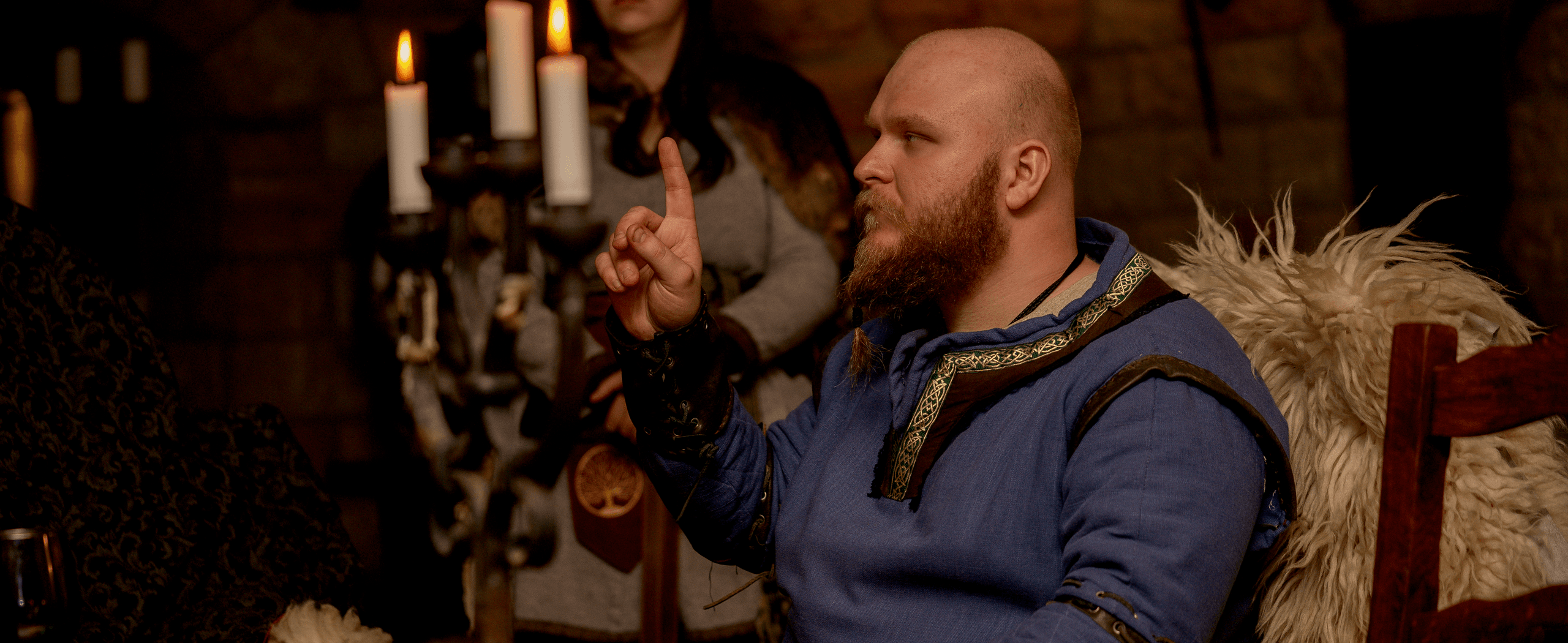
Two pairs of letters govern everything in LARP. English-speaking LARP calls them IC (in character) and OOC (out of character). German LARP — and therefore our own events — uses IT (in time, in play) and OT (out of time, outside play). They mean exactly the same thing, and you'll hear both on our fields. In this guide we use IT and OT, because that's what the person next to you at the campfire will say.
What do IC/OOC and IT/OT mean?
IT means: you are your character. What you say, know, feel, and do counts as your character's action in the game world.
OT means: you are yourself, the person behind the character. What you say or do in this mode does not exist in the game world.
An analogy from theatre: IT is the scene in front of the camera. OT is when the director calls "Cut!" The difference between good LARP and poor LARP often lies precisely in how clearly this boundary is drawn and upheld.
When Are You IT, When Are You OT?
As a rule: everything on the game field is IT, as long as no timestop has been called. You carry your character, you speak as your character, you react to what happens to your character.
You become OT when:
- You use a safety gesture or call the safeword
- You are in a designated OT area (such as the backstage area or a first-aid station)
- The game master has called a general timestop
- You personally need a break
Switching between IT and OT is not a weakness — it is responsible handling of yourself and others.
Metagaming in LARP: what your character knows and what you know
This is where the real challenge lies. As a player you know things your character cannot: information from other conversations, plans of other groups you overheard by accident, meta-knowledge about the setting.
Metagaming is the practice of playing on the basis of knowledge your character does not possess. It destroys the balance of the story and the trust of other players. Not metagaming is one of the most difficult skills to learn in LARP — because it requires actively separating what you know from what your character knows.
A rule of thumb: if you're unsure whether your character could know a piece of information, the answer is usually: no.
Common Immersion Breaks — and How to Avoid Them
Even experienced LARPers have bad moments. The most common:
Using your phone visibly on the game field — being seen on the phone pulls not only you but everyone around you out of the game. If you genuinely need your phone, go to an OT area.
OT conversations in the middle of a scene — logistics, weather complaints, schedule changes: these don't belong on the game field during IT. Step briefly OT, sort out the issue, and return.
Letting your own mood bleed into the character — if you're tired, hungry, or frustrated, your character shouldn't be the outlet for that. These states affect the quality of the game for everyone. Take a proper break, eat something, and come back. How strongly character and player rub off on each other in the other direction is the subject of our post on bleed and the post-LARP blues.
Using characters to settle personal conflicts — if you have a real problem with another player, the character is not the right vehicle. Sort it out OT, after the event, in a calm conversation.
When You Must Go OT
Safety always comes before IT. Go OT immediately when:
- Someone is injured or needs medical assistance
- You feel uncomfortable or overwhelmed
- A situation feels wrong to you — in terms of content, physically, or emotionally
- You suspect that someone else seriously needs an OT break
There is never a bad time to step off the game field briefly when it is necessary. A good LARP community respects this.
Safety gestures, safewords and meta-techniques
Most events use agreed signals to enable OT communication without fully breaking the atmosphere. Common ones:
- Hand on head / forearms crossed — "I am OT right now, please don't involve me in play"
- Raised fist or outstretched arm — timestop, everyone freezes
- Thumbs up — "Everything is fine, just a brief OT pause"
Beyond these, there are special meta-techniques that allow OT needs to be communicated without visibly stepping out of the game:
"Wirklich wirklich" ("Really really") — a short OT bracket in the middle of a conversation. Whoever says the phrase signals to the other: what I am about to ask or say, I mean as a player, not as a character. Example: "Are you really really okay?" means: OT — are you genuinely alright right now? The answer counts accordingly. The technique allows care and consent-checking to be built in discreetly, without needing a visible OT gesture.
"Oh Mutter" ("Oh Mother") — an unobtrusive code signal. Whoever says it signals to the game master or safety team: I need OT attention right now but cannot openly go OT. Safety personnel at events that use this technique are trained to recognise the phrase and respond discreetly — a quiet word aside, not a loud timestop. This keeps the game atmosphere intact for everyone else while the person receives support.
Neither technique is universally used — check before each event whether and how they are implemented there. Learn your event's signals before play begins. They are part of the safety infrastructure, not optional.
IT and OT as a Form of Respect
Consistently playing IT and respecting OT signals: I take this shared experience seriously. That creates trust. And good collective play is built on trust.
Nils Jäkel has organized summer-theater events for five years and has attended LARP events for the same span; for four years he has also been a camp organizer at one of the largest camps at Conquest of Mythodea, the world's largest LARP event. He spent four years chairing a theater association's board, and for the past two years has served as board chair of the State Association for Amateur Theater Saxony (Landesverband für Amateurtheater Sachsen).
A regular letter from our world: news on events, contributions, and lore — sent straight from Avarra to your inbox.