
The Gambeson: The Most Underrated Piece of LARP Armour
Why you should buy one before the mail shirt — and how to spot a good one
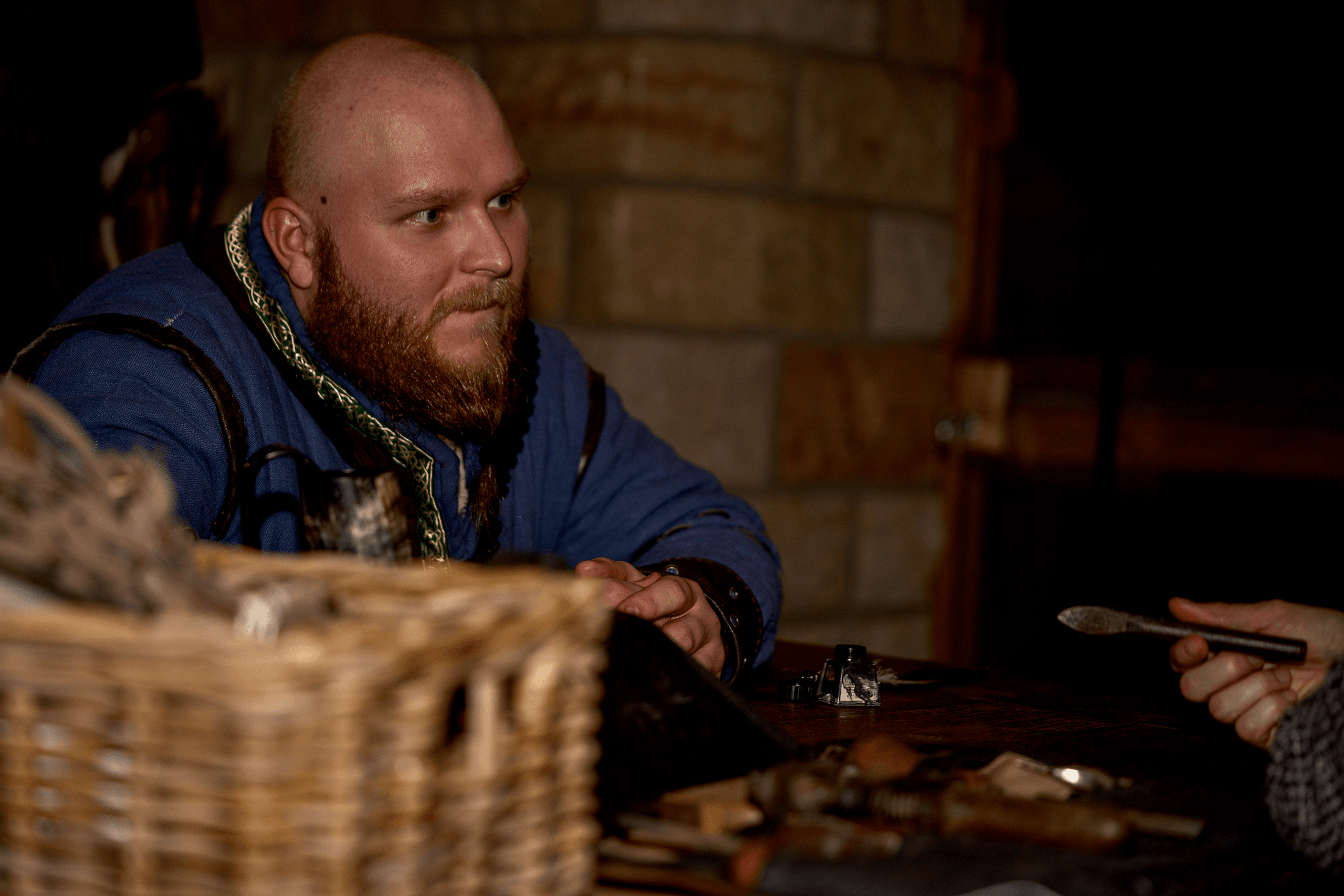
There's one mistake almost everyone makes. You've finally bought a mail shirt — your first real piece of armour, heavy, jingling, glorious. You pull it on over your linen shirt, walk onto the field and feel invincible.
Until Saturday lunchtime.
Then the weight bites into your shoulders, the rings grind against your collarbones, and every hit the mail is supposedly stopping still arrives as a bruise. By Sunday you're only putting it on for photos.
What was missing is a garment no medieval fighter would have forgotten: the gambeson. Which is exactly why experienced players will tell you to buy one before the mail shirt, not after.
We're a non-profit and we're not selling you anything. So this guide also tells you when you don't need one.
What is a gambeson?
A gambeson is a padded, quilted textile jacket worn as armour — either on its own or as the padded layer beneath mail and plate. The German-language Wikipedia describes it as a textile armour piece made either of multiple layers of linen or stuffed with materials such as raw wool or cloth scraps, quilted in both cases, usually in channels or a diamond pattern.
Put plainly: it's a very thick, very sturdy quilted jacket that looks like it has already survived a siege. That's the point.
In English you'll also encounter padded armour, arming doublet and aketon.
Gambeson, aketon, doublet, surcoat — what's what?
These terms get muddled constantly, shops included.
Gambeson is the umbrella term for padded textile armour.
Aketon refers more narrowly to the many-layered version: the German LARP wiki puts it at 8 to 25 layers of sturdy cloth, usually diamond-quilted, with no weak points at the seams. The word may derive from Arabic al-qutn, "cotton".
Padded doublet (German Polsterwams) is the most common LARP construction: two layers of fabric with wadding between them — polyester, wool or cotton — quilted through. Cheaper, lighter, less historical. Not to be confused with the historical padded jack, which was a many-layered garment in its own right.
Arming doublet (German Rüstwams) is the close-fitting, lightly padded version made for late-medieval plate.
Doublet (German Wams) is the gambeson's closest linguistic relative: both words trace back to Old High German wamba, "belly".
Surcoat (German Waffenrock) is something else entirely — and this is the commonest confusion. A surcoat is a usually sleeveless overgarment worn over armour, displaying arms or colours. It pads nothing. It's a sign, not protection.
If these terms keep coming up, the glossary collects them alongside the rest of the scene's vocabulary.
A look back: where the gambeson comes from
Wrapping yourself in many layers of cloth to blunt a blow is far older than medieval Europe. Greek goldwork shows Scythian riders in quilted leather jackets and trousers — so the idea is at least 2,400 years old, even if images alone can't tell us how much of that was armour and how much was clothing.
For the European gambeson itself, sources disagree: German Wikipedia calls it "attested from the thirteenth century", while the English-language article traces standalone gambesons back to at least the late tenth century. What can be said safely is that across the High and Late Middle Ages it was a matter of course all over Europe — worn by knights under mail, and worn thicker by common soldiers as the only armour they could afford.
One much-cited image is the 1366 tomb slab of Theoderich von Lichtenhayn in the Predigerkirche in Erfurt: German Wikipedia reads the figure as wearing a gambeson under mail, while effigy scholarship describes the outer garment as a jupon — an overgarment. A neat illustration of how hard textile armour is to identify in stone.
From the fifteenth century onwards, brigandines and plate increasingly took over as primary armour — without the gambeson disappearing: it stayed as the padding underneath, and padded jacks remained common among foot troops for a long time.
And in fairness: how well a gambeson actually protected is disputed. Experiments cited by the German Wikipedia found it effective against ranged weapons and sword cuts, but not against thrusts. If you read somewhere that a gambeson was "arrow-proof" or "thrust-proof", that's too simple. For LARP the question is relaxed anyway — there, what hits you is foam and latex.
What did people wear under armour?
Short answer: a gambeson — with a linen shirt beneath it. Wearing metal armour without padding hands your body four problems at once:
- Pressure. Mail hangs from the shoulders and neck. Without padding, all of that weight sits on a narrow strip of you.
- Chafing. Metal edges and rings work through cloth and then through skin. On a three-day event that isn't theoretical.
- Blunt force. Mail catches cuts, not impact — and only limited protection against thrusts. The padding underneath is the part that actually absorbs blows.
- Fit. A plate piece that wobbles on its own suddenly sits where it should over a gambeson.
Hence the sequence treated almost as a law of nature in LARP: gambeson first, then metal. Where it goes from there — leather, brigandine, plate — is mapped out in our overview from beginner to prestige kit.
Why a gambeson does so much in LARP
Even without mail, it's one of the best investments a character can make — for five reasons.
It changes your silhouette. A gambeson makes you broad. Shoulders, chest, upper arms — everything reads as more massive. For a warrior character it's the cheapest route to presence; no piece of steel buys you that much presence for eighty euros.
It works on its own. A gambeson is historically documented armour, not a stopgap. A character in gambeson, belt and boots is fully armoured and needs to apologise to nobody.
It sometimes counts mechanically. Some rule sets treat padded armour as an armour class of its own. Check your event's rules — a gambeson may earn hits that a leather coat won't.
It keeps you warm. If you play in October or November you'll love it. A gambeson is essentially armour with central heating.
It fits almost any setting. Medieval, fantasy, viking, post-apocalyptic, mercenary, town guard: the shape works everywhere as long as colour and fabric are right. How it fits into a coherent overall look is covered in costume and equipment.
Seven things to check before you buy
1. Outer material. Linen gives a better microclimate than cotton and looks more convincing, but costs more. Cotton canvas is the sturdy, widely available compromise. Avoid pure synthetics: they trap heat, and the smell sticks after two events.
2. Wadding. Polyester is light, cheap and dries fast, but breathes poorly. Wool or cotton wadding is more comfortable and dearer. What matters more than the material: is the padding quilted evenly? If the filling migrates downwards inside the quilted panels, after one season you own a garment with thick hips and thin shoulders.
3. Don't fixate on layer counts. Layer counts between 2 and 30 get thrown around, depending on construction, and shops advertise with them. But a high layer count only makes sense in a true aketon, and mostly means heavier, hotter, pricier. For LARP combat with foam weapons, a well-fitting padded doublet beats any oversized aketon.
4. Sleeves: fixed, detachable or none. Detachable sleeves — usually laced or buttoned — are the most flexible option: long-sleeved in October, sleeveless in July. Short sleeves are a good summer compromise. Sleeveless is cool but won't protect your arms from mail chafing.
5. Length. Short (to the hip) is more mobile and cheaper. Long (mid-thigh or beyond) protects more and looks weightier, but can be a nuisance sitting, riding and in a tent. Rule of thumb: fight a lot, go short to medium. Represent a lot, go long.
6. Fit — over everything else you wear. The commonest online-buying error. Measure yourself with undershirt and tunic on, not in your underwear. The gambeson has to go over that, and nothing beneath may pull. Leave room up top in case mail joins later. Buy it tight and you'll buy it twice.
7. Colour and closure. Natural, beige, brown, dark green, grey and black are the safest colours and suit nearly any setting. Strong red or blue works but visually ties you to a faction. On closures: lacing adapts (handy if your weight changes), buttons and buckles are faster, zips fastest — but they break the illusion as soon as they're visible.
Gambesons for women
Most gambesons are sold in unisex cuts, which in practice means men's measurements. That produces two familiar problems: it pulls across the chest while the shoulders sit too wide, and the length falls awkwardly.
What helps: models with side lacing or buckles that can be adjusted. Makers who explicitly offer a women's cut. And where possible, made to measure or altered. A gambeson is expensive enough that alteration costs pay for themselves — and one that fits wears completely differently from one that doesn't.
Don't let anyone tell you that you need a "lighter" model because you're a woman. What you need is one that fits.
The heat trap: the most important section here
A gambeson is armour that warms you. In October that's a gift; in July it's a hazard. The German LARP wiki is explicit about one thing: a bright red face can be a warning sign of overheating — don't just write it off as effort.
- Drink regularly and across the day, not only when thirsty. When you're sweating heavily, salt and electrolytes belong with it — very large volumes of plain water are not a good idea.
- Know the warning signs: headache, dizziness, nausea, muscle cramps, weakness. Do not rely on someone stopping sweating — in exertional heat illness most casualties keep sweating. Dry skin belongs to classic heatstroke in a heatwave, not to the fighter-in-armour case.
- Confusion, slurred speech, aggression, seizure or loss of consciousness is an emergency. Then: armour off, get the event medics or call emergency services, into the shade, cool actively (cold water over head, neck, armpits, groin) — don't wait to see whether it improves.
- Take the armour off the moment it starts turning. No plot is worth it. And say it out loud: "OOC, I feel ill" is never embarrassing at any event.
- Watch out for others. People in armour are often the last to notice their own state. If someone in camp goes red, quiet and unsteady: shade, armour off, cool, let them drink — and get the event medics, calling emergency services if in doubt.
- Don't layer heavily underneath. A light linen shirt under the gambeson is right. A fleece is not.
This isn't small print. Heat problems are among the most common reasons the medics get called at summer events, and armour raises the risk considerably. What applies elsewhere on the field is covered in weapons and safety.
This section is not medical advice. In an emergency: event medics, or your local emergency number.
Care: making it last
A gambeson is not a T-shirt, and it often won't survive a washing machine — the wadding clumps and shifts.
- Airing does half the work of washing. Hang it up after every event, somewhere airy, until it is completely dry. Not rolled into the boot of the car and forgotten there.
- Spot-treat stains instead of washing the whole thing.
- Wash only as the maker specifies. If washing is allowed: cold, gentle cycle, no spin — and dry it flat so the filling doesn't travel downwards.
- Store it dry. A gambeson stored damp will mould, and then it's finished.
- Check and mend the seams. Which is exactly what medieval fighters did: clean, patch, keep wearing.
Sewing your own?
Possible, but don't underestimate it. A gambeson means many layers, and many layers mean a strong machine, a great deal of fabric, patience with the quilting, and a pattern that fits over everything going underneath. There are good sewing guides online, and anyone who has already made garb can manage it.
As a first sewing project, though, it's a hard choice. If you want to learn to sew, start with a tunic. And if the idea appeals: ask around — nearly every group has someone with a machine who'd enjoy the company.
LARP, reenactment and HEMA — three different requirements
Worth knowing before you buy, because these audiences buy differently:
LARP: looks, comfort and setting suitability matter. Historical accuracy is secondary and fantasy elements are welcome. A padded doublet is entirely enough.
Reenactment and living history: here the evidence matters. Cut, material, stitching and dating must match the period and region portrayed. Polyester wadding is out. That costs more and demands research.
HEMA and display fighting: here it's protection against real force — blunt steel, feders, hard hits. Look for gear with an explicit protection rating (350 N / 800 N, in line with EN 13567) and check your club's or federation's requirements. A LARP gambeson is not built for that.
If you want to do both, buy for the harder requirement. It doesn't work the other way round.
Don't buy it first, but buy it early
The gambeson has the best value-for-effect ratio of any piece of armour. It makes your character bigger, your fights more bearable and your October event warmer — and it's the precondition for a mail shirt ever being a joy rather than a backache.
One piece of advice worth more than any checklist: try one on first. Ask someone at your next event who has one. Two minutes inside somebody else's gambeson will tell you more about length, weight and heat than any product description. And incidentally, it's exactly the kind of conversation that turns into friendship in this scene.
More groundwork for getting started is in our LARP guides. And when you're ready to test your armour in play: come and see when we next take the field together.
Frequently Asked Questions
Simple padded doublets start at roughly 60 to 90 euros. Good mid-range — which is where detachable-sleeve models sit — runs about 110 to 190 euros. Historically made or bespoke pieces go well above that. Prices move, so treat this as orientation rather than a promise.
No. For your first event you need garb, shoes and a belt. The gambeson is a wonderful second or third purchase, especially if your character fights.
Yes, and historically that was the norm for many fighters. It is armour in its own right, not underwear.
A light linen or cotton shirt. It catches sweat, protects your skin and can be washed — unlike the gambeson itself.
No. The gambeson pads, and is worn under armour or as armour. A surcoat goes over armour and displays arms or colours. It pads nothing.
Gambeson, or the older spelling Gambison. Related German terms are Polsterwams for the padded doublet, Aketon for the many-layered version, Rüstwams for the arming doublet, and Waffenrock for the surcoat worn over armour.
No. HEMA and display fighting need protection against real force, and gear there carries an explicit puncture rating — 350 N or 800 N, in line with EN 13567. A LARP gambeson is not built for that. If you want to do both, buy for the harder requirement.
Nils Jäkel has organized summer-theater events for five years and has attended LARP events for the same span; for four years he has also been a camp organizer at one of the largest camps at Conquest of Mythodea, the world's largest LARP event. He spent four years chairing a theater association's board, and for the past two years has served as board chair of the State Association for Amateur Theater Saxony (Landesverband für Amateurtheater Sachsen).
A regular letter from our world: news on events, contributions, and lore — sent straight from Avarra to your inbox.